GPT Image 2.6: what's new, what it costs and how it does on real ads
Updated
GPT Image 2.6 is OpenAI's newest image model, released on 4 November 2026 in ChatGPT, Codex and the API. It comes in two versions: Sunburst, OpenAI's base model for detail and precise edits, and Flare, a smaller model for speed. Both cost the same per token as GPT Image 2.5. The release adds a complexity setting, SVG and animated GIF output and edits guided by marks drawn on the image, and OpenAI says the models generate images 50% faster than before.
We ran both versions through Mockingbird's production ad pipeline the day after launch, with identical prompts and five reference images, at high quality. A 4:5 Meta ad cost between $0.088 and $0.108 on every model we tried. Flare finished in 16 to 26 seconds, Sunburst 2.6 in 51 to 55 seconds and Sunburst 2.5 in 37 to 39 seconds. Mockingbird now renders paid ads on Sunburst 2.6 and the free first ad on Flare.
What is GPT Image 2.6?
GPT Image 2.6 is the newest model in OpenAI's GPT Image line, following GPT Image 2.5 in September 2026 and gpt-image-2 before it. It takes text and images in and returns an image, so it can make a picture from a prompt or edit and combine pictures you upload. The API model IDs are gpt-image-2.6-sunburst and gpt-image-2.6-flare, and they work on the Image API's generations and edits endpoints only: unlike 2.5, they are not available through the Responses API or the Batch API.
Like 2.5 before it, 2.6 comes as a pair with the same prices and features. OpenAI calls Flare the smaller model, for workflows where speed matters most, and Sunburst the base model, for more detail or precise edits. Our full comparison is in GPT Image 2.6 Sunburst vs Flare.
If you still use an older model, note the deadline: OpenAI shuts down gpt-image-1.5, gpt-image-1-mini and chatgpt-image-latest on 1 December 2026 and names the 2.6 models as their replacement.
What's new in GPT Image 2.6
These are the changes OpenAI lists for the 2.6 models. None of them changes the token price.
Complexity. A new setting that controls how much the model plans before it renders, with three levels: low, medium and high, the default. OpenAI recommends lower levels for focused edits and higher levels for dense text and complex layouts, and warns that higher levels can add time and unwanted changes. It carries no separate fee.
SVG output. Set output_format to svg on a generation request and the API returns one static vector file. Edits do not support SVG.
Animated GIF output. Set output_format to gif on a generation or an edit, with 2 to 16 frames (9 by default) shown for 20 to 2,000 milliseconds each (200 by default).
Markup-guided edits. You draw on a transparent layer the same size as the first image and send it with an edit request, so the model knows exactly where to change things. This works on the 2.5 and 2.6 models.
Speed. OpenAI says both models generate images 50% faster than before, and that Flare can return an image in as little as six seconds at low quality.
Provenance. OpenAI's system card says images carry C2PA metadata and a SynthID watermark.
Quality still runs from low through medium and high to xhigh and max, plus auto. Custom sizes need both sides divisible by 16, no side longer than 3,840 pixels and a shape between 1:3 and 3:1.
Sunburst and Flare at a glance
Both versions cost the same per token. In our tests they cost the same per image too, within a tenth of a cent, because Flare returned about 3% more output tokens. The real difference was time.
| Sunburst | Flare | |
|---|---|---|
| API model ID | gpt-image-2.6-sunburst | gpt-image-2.6-flare |
| OpenAI's description | Base model, for detail and precise edits | Smaller model, for speed |
| Price per 1M tokens | $8 image in, $5 text in, $30 image out | $8 image in, $5 text in, $30 image out |
| Our 4:5 ad, time | 51 to 55 seconds | 16 to 26 seconds |
| Our 4:5 ad, cost | $0.088 to $0.107 | $0.089 to $0.108 |
| Where Mockingbird uses it | Every paid ad | The free first ad |
How much does GPT Image 2.6 cost?
OpenAI charges by the token, not by the image: $8 per million image input tokens, $5 per million text input tokens and $30 per million image output tokens. There is no Batch discount for 2.6 yet. The price of one picture depends on how many reference images you send and how large and detailed the output is.
In our tests a 1088 x 1360 ad at high quality used about 1,600 output tokens, roughly $0.048 of the bill. Five reference images added $0.04 to $0.06 of input. A single-image edit came to $0.060. The full breakdown, with a worked example and what 100 ads cost, is in GPT Image 2.6 pricing.
How GPT Image 2.6 did on a real ad
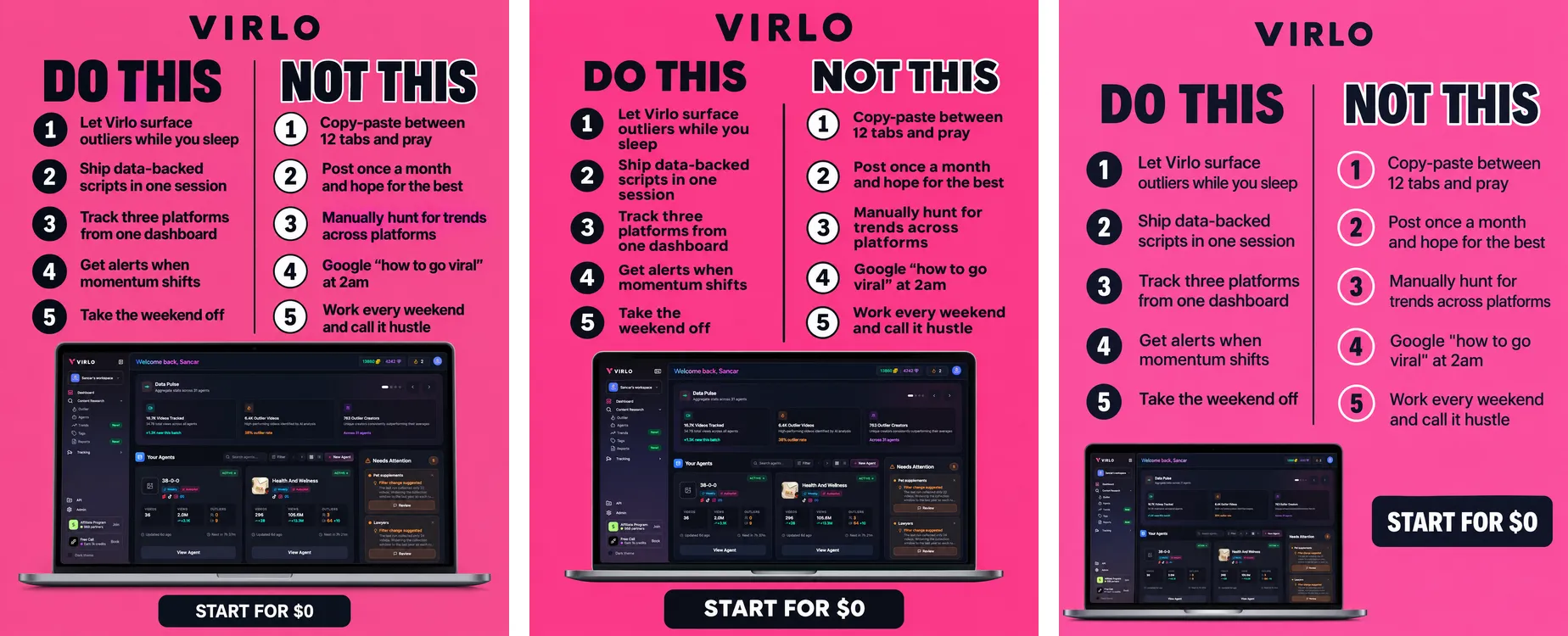
We remade a list-style ad ("DO THIS / NOT THIS") for Virlo, a short-form video analytics tool, using the reference ad and four screenshots of Virlo's dashboard as inputs. The prompt, images, size (1088 x 1360) and quality (high) were identical for each model. We ran a second remake with four product photos of a supplement bottle, to test packaging accuracy.
| Model | Dashboard ad | Packaging ad | Cost per ad |
|---|---|---|---|
| GPT Image 2.5 Sunburst | 37 seconds | 39 seconds | $0.088 / $0.107 |
| GPT Image 2.6 Sunburst | 51 seconds | 55 seconds | $0.088 / $0.107 |
| GPT Image 2.6 Flare | 16 seconds | 26 seconds | $0.089 / $0.108 |
What we saw in the images
All three models spelled every line of copy correctly, kept Virlo's real dashboard figures legible on the laptop screen and copied the supplement label word for word, small print included. The differences were in layout and style.
Flare followed the reference ad most closely. On the dashboard ad it kept the laptop in the bottom left with the button beside it, as the reference does, and on the packaging ad it reproduced the reference's outlined lettering. Sunburst 2.6 set bigger, bolder type, and both Sunburst versions stacked the laptop under the lists. None of the three changed the product's colour, a fault we saw on GPT Image 2.5 Flare in September.
Should you switch to GPT Image 2.6?
If you use GPT Image 2.5 today, the switch costs nothing extra and Flare 2.6 gives you the fastest renders we have measured from OpenAI. OpenAI's "50% faster" held for Flare in our tests, but at high quality with reference images Sunburst 2.6 was slower than Sunburst 2.5 on launch day. If speed matters more than OpenAI's detail and consistency pitch, pick Flare. Our side-by-side of the two generations is in GPT Image 2.6 vs 2.5.
On the public Arena leaderboards of 2 November 2026, OpenAI's GPT Image models held the top five places for text to image, with 2.6 Sunburst second on early votes at medium quality and Google's Nano Banana 2.1 seventh. GPT Image 2.6 vs Nano Banana 2.1 compares the two directly, and the best AI image models for ads covers eleven models for ad work.
Using GPT Image 2.6 for Meta ads
The models take custom sizes, so you can ask for Meta's exact ratios. Both sides must be divisible by 16, and 1080 is not, so we request 1088 x 1360 for a 4:5 feed ad, 1088 x 1088 for 1:1 and 1152 x 2048 for 9:16, then scale down to 1080 x 1350, 1080 x 1080 and 1080 x 1920. Put the reference ad first among the input images and say plainly that its brand, product and words must not be copied.
The step-by-step version, with the settings and prompt structure we use, is in how to make Facebook ads with GPT Image 2.6. If you would rather not write prompts at all, Mockingbird does the whole process from a winning ad and your product photos, and renders it on GPT Image 2.6.
Frequently asked questions
- When was GPT Image 2.6 released?
- OpenAI released GPT Image 2.6 on 4 November 2026 in ChatGPT, Codex and the API, where it comes as two models: gpt-image-2.6-sunburst and gpt-image-2.6-flare.
- What is the difference between GPT Image 2.6 Sunburst and Flare?
- OpenAI calls Sunburst its base model, for detail and precise edits, and Flare a smaller model for speed. They cost the same per token. In our ad tests Flare was two to three times faster at the same cost per image, and its quality matched Sunburst's on the ads we made.
- How much does GPT Image 2.6 cost per image?
- There is no flat price per image. OpenAI charges $8 per million image input tokens, $5 per million text input tokens and $30 per million image output tokens. Our 4:5 ads cost $0.088 to $0.108 each with five reference images, and a single-image edit cost $0.060.
- Is GPT Image 2.6 more expensive than GPT Image 2.5?
- No. The token prices are the same, and in our side-by-side test GPT Image 2.5 Sunburst and 2.6 Sunburst used exactly the same number of tokens for the same ad.
- Can GPT Image 2.6 make SVG files and GIFs?
- Yes. Set output_format to svg on a generation request for a static vector file, or to gif on a generation or edit for an animation of 2 to 16 frames.
- Is GPT Image 2.6 available in the Responses API?
- No. OpenAI's model pages list only the Image API's generations and edits endpoints for 2.6. GPT Image 2.5 remains available as a Responses API tool.
Sources
- OpenAI API changelog, 4 November 2026
- OpenAI model page: gpt-image-2.6-sunburst
- OpenAI model page: gpt-image-2.6-flare
- OpenAI image generation guide
- OpenAI image prompting guide
- OpenAI API pricing
- OpenAI API deprecations
- OpenAI system card: ChatGPT Images 2.6
- OpenAI Developers on X, 4 November 2026
- OpenAI Developer Community: Introducing ChatGPT Images 2.6
- Arena text-to-image leaderboard (snapshot of 2 November 2026)
Keep reading
GPT Image 2.6 Sunburst vs Flare: which one should you use?
Sunburst and Flare on the same jobs: speed, cost, quality and edits.
GPT Image 2.6 pricing: what one image actually costs
Per-token prices, what our images really cost, and how to spend less.
GPT Image 2.6 vs Nano Banana 2.1: which is better for ads?
OpenAI's and Google's newest image models, compared for ad work.