GPT Image 2.6 Sunburst vs Flare: which one should you use?
Updated
Use GPT Image 2.6 Flare when speed matters and Sunburst when you want OpenAI's base model for detail and precise edits. Both cost the same per token. In our tests on the same ads, thumbnail and edit, Flare finished in 15 to 26 seconds against 40 to 55 seconds for Sunburst, cost the same per image to within a tenth of a cent, and matched Sunburst's text and product accuracy.
Flare also copied the reference ad's layout more closely and changed the least when we asked for a one-line edit. Sunburst set bigger, bolder type. Mockingbird uses Flare for the free first ad, where speed counts most, and Sunburst for every paid ad.
The short answer
OpenAI calls Flare the smaller model, for workflows where speed matters most, and Sunburst the base model, for more detail or precise edits. It also says that at medium or high quality Sunburst keeps details more consistent from one edit to the next. Both support the same new features, including the complexity setting, SVG and GIF output and markup-guided edits. Here is how they compared on our jobs.
| Sunburst 2.6 | Flare 2.6 | |
|---|---|---|
| Speed in our tests | 40 to 55 seconds | 15 to 26 seconds |
| Cost per 4:5 ad | $0.088 to $0.107 | $0.089 to $0.108 |
| Text accuracy | Every line correct | Every line correct |
| Product label accuracy | Word for word | Word for word |
| Follows the reference layout | Loosely, with bigger type | Closely |
| Change outside a one-line edit | 12.5 at default complexity | 6.4 at low complexity |
| Choose it for | Detailed work, OpenAI's quality pick | Speed, iteration, edits |
Speed: Flare was fastest in every test
We ran four jobs on 5 November 2026, the day after launch, with identical inputs per model, at high quality. Times are from sending the request to receiving the image. OpenAI says Flare can return an image in as little as six seconds at low quality; our jobs used high quality and up to five reference images, so they took longer. Launch-week load may also have slowed both models, so treat these as a snapshot.
| Job | Sunburst 2.6 | Flare 2.6 |
|---|---|---|
| 4:5 ad, five reference images (dashboard) | 51 seconds | 16 seconds |
| 4:5 ad, five reference images (packaging) | 55 seconds | 26 seconds |
| 16:9 thumbnail, four reference images | 40 seconds | 16 seconds |
| One-line edit of a finished ad | 47 seconds | 15 seconds (complexity low) |
Cost: the same to a tenth of a cent
Both models charge $8 per million image input tokens, $5 per million text input tokens and $30 per million image output tokens. Input was identical for each job, so the only difference was output. At 1088 x 1360 and high quality, Sunburst returned 1,587 output tokens and Flare 1,629, which made Flare about $0.001 dearer per ad. At 1536 x 864 the two were within two tokens of each other. Full workings are in GPT Image 2.6 pricing.
Quality on a real ad
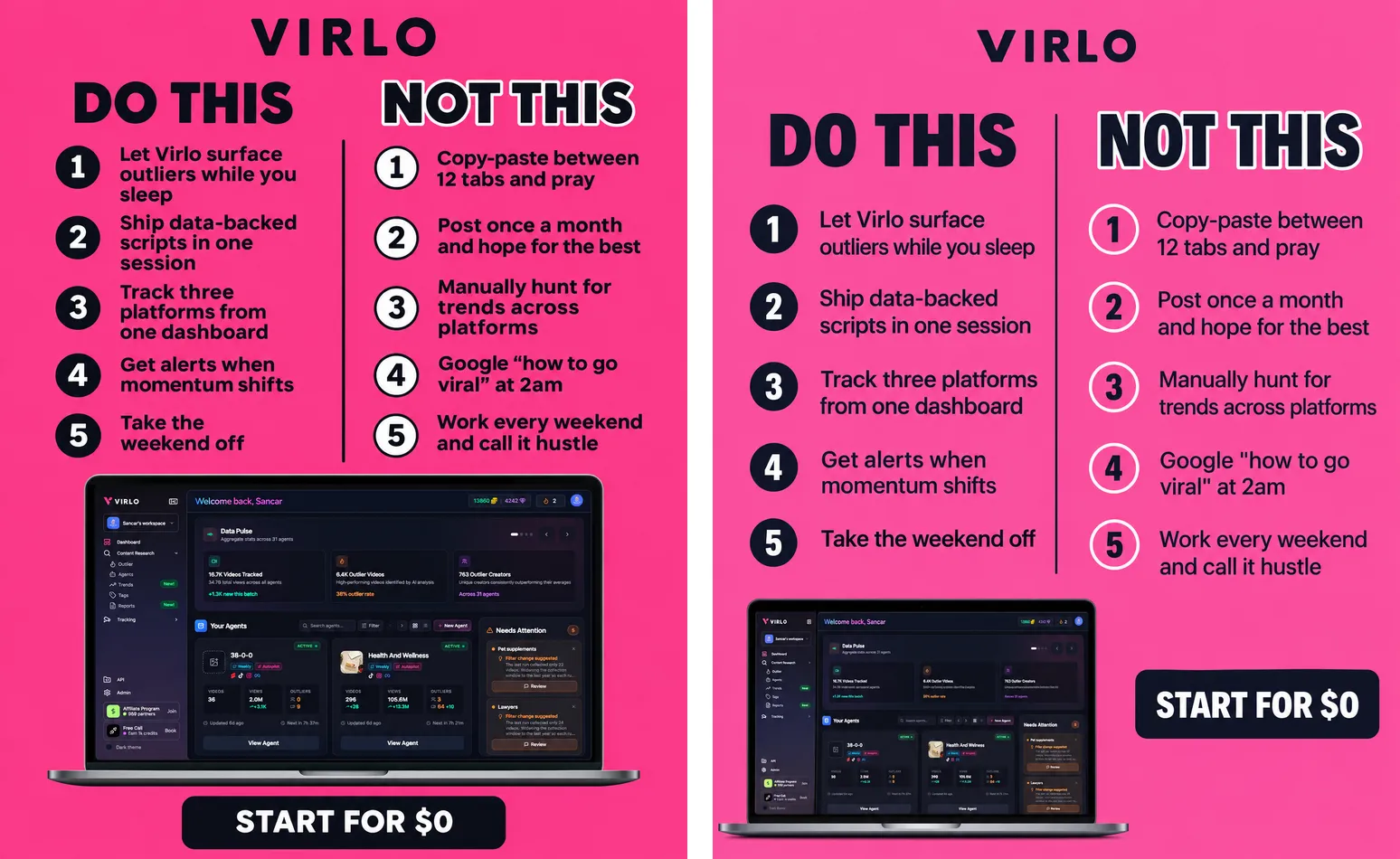
We remade a "DO THIS / NOT THIS" list ad for Virlo, with the reference ad and four dashboard screenshots as inputs. Both models spelled every line correctly and kept the dashboard's real figures legible. Flare kept the reference's structure, with the laptop in the bottom left and the button beside it. Sunburst made the headline and list larger and moved the laptop under the lists.
On a second ad with four photos of a supplement bottle, both copied the label word for word, including the small print, and kept the gummies their true dark colour. Flare also reproduced the reference's outlined lettering there. On a YouTube thumbnail edit with three portrait photos as references, both kept the face recognisable and drew the website in the scene cleanly.
Edits: Flare on low complexity changed the least
Edits are where the new complexity setting matters. We asked each model to change only the button text on a finished ad, from "START FOR $0" to "TRY IT FREE", then measured how much the rest of the image moved: the average difference per pixel outside the button, on a 0 to 255 scale. Lower means the rest of the ad stayed closer to the original.
| Model and setting | Time | Change outside the button |
|---|---|---|
| Sunburst 2.6, complexity high (default) | 47 seconds | 12.5 |
| Sunburst 2.6, complexity low | 33 seconds | 8.6 |
| Flare 2.6, complexity low | 15 seconds | 6.4 |
All three changed the button correctly. Low complexity made Sunburst about 15 seconds faster and steadier at no extra cost, which fits OpenAI's advice to use lower levels for focused edits. OpenAI's consistency claim for Sunburst is about keeping details steady across a chain of edits at medium or high quality, which this single-edit test does not measure.
When to use Sunburst and when to use Flare
Use Flare for drafts, batches, anything a person is waiting on, and small edits to a finished image.
Use Flare with complexity set to low when you only want to change one thing.
Use Sunburst when you want OpenAI's pick for detailed work, and the wait does not matter.
Keep complexity on its default of high for dense text and busy layouts, whichever model you use.
Test both on your own images before you commit: the gap in quality on our ads was small, and yours may differ.
What Mockingbird uses
Mockingbird renders the free first ad a new brand sees on Flare, so it arrives quickly, and every paid ad on Sunburst, OpenAI's model for detailed work. On our production pipeline, which also writes the prompt with Claude, a Flare ad took 37 seconds end to end and a Sunburst ad 63 seconds.
Frequently asked questions
- Is GPT Image 2.6 Flare cheaper than Sunburst?
- No. Both cost $8 per million image input tokens and $30 per million image output tokens. In our tests Flare returned slightly more output tokens, so it cost about $0.001 more per 4:5 ad.
- Is Sunburst better quality than Flare?
- OpenAI calls Sunburst its base model, for detail and precise edits, and says it keeps details more consistent across a series of edits. On our ads both models were equally accurate on text and product labels; Flare followed the reference layout more closely and Sunburst set larger type.
- How much faster is GPT Image 2.6 Flare?
- In our four tests on 5 November 2026 Flare took 15 to 26 seconds and Sunburst 40 to 55 seconds, so Flare was two to three times faster.
- Which model should I use for image edits?
- In our one-line edit test Flare with complexity set to low changed the least of the image outside the edit, and finished in 15 seconds.
Sources
Keep reading
GPT Image 2.6: what's new, what it costs and how it does on real ads
OpenAI's newest image model, what changed, and how it did on real ads.
GPT Image 2.6 vs 2.5: what changed, and is it worth switching?
Same price, new features: 2.5 and 2.6 tested on the same ads.
GPT Image 2.6 pricing: what one image actually costs
Per-token prices, what our images really cost, and how to spend less.